
Rules of Noon Sakinah and Tanween: A Complete Guide to Tajweed
Learning the rules of Noon Sakinah and Tanween is an essential step toward mastering Quran recitation. These rules help students understand how to pronounce specific Arabic sounds correctly when reading the Holy Quran.
For beginners, understanding these rules may seem difficult at first. However, with clear explanations, practical examples, and guidance from qualified teachers, students can learn them gradually.
At Alnoor Academy, we offer personalized online Tajweed classes to help children and adults improve their Quran recitation and understand the essential rules of Tajweed.
What Is Noon Sakinah?
Noon Sakinah is the Arabic letter Noon (ن) without a vowel (Sukoon).
It appears in different positions within Quranic words and has four main Tajweed rules depending on the letter that follows it.
What Is Tanween?
Tanween is a double vowel sign placed at the end of certain Arabic words.
There are three types of Tanween:
- Fathatain (ً)
- Kasratain (ٍ)
- Dammatain (ٌ)
Tanween produces an additional Noon sound when connected to the following word, and its pronunciation follows the same four rules as Noon Sakinah.
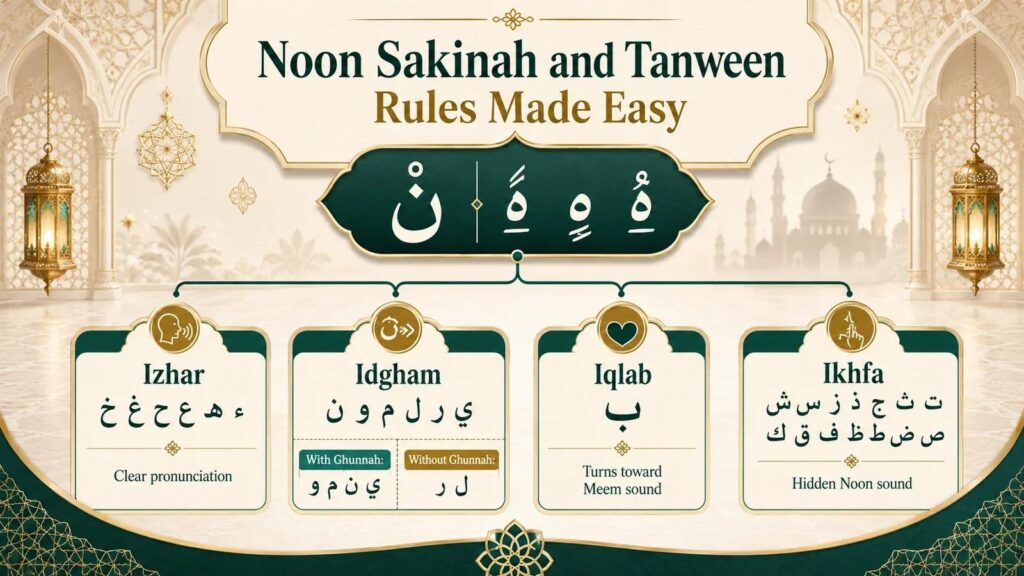
The Four Rules of Noon Sakinah and Tanween
1. Izhar (Clear Pronunciation)
Izhar means making the Noon sound clear without merging it into the following letter.
It occurs when Noon Sakinah or Tanween is followed by one of the six throat letters:
ء، ه، ع، ح، غ، خ
Students should pronounce the Noon sound clearly and naturally.
2. Idgham (Merging)
Idgham means merging the Noon sound into the following letter.
It occurs when Noon Sakinah or Tanween is followed by one of these six letters:
ي، ر، م، ل، و، ن
Idgham is divided into two types:
Idgham with Ghunnah:
ي، ن، م، و
Idgham without Ghunnah:
ل، ر
Learning the difference between these two types helps students improve their recitation accuracy.
3. Iqlab (Conversion)
Iqlab means changing the Noon Sakinah or Tanween sound into a hidden Meem sound when followed by the letter:
ب
This rule is accompanied by Ghunnah.
Students should practice Iqlab carefully to understand the correct nasal sound.
4. Ikhfa (Concealment)
Ikhfa means pronouncing Noon Sakinah or Tanween between Izhar and Idgham, while maintaining Ghunnah.
It occurs when the following letter is one of the fifteen Ikhfa letters:
ت، ث، ج، د، ذ، ز، س، ش، ص، ض، ط، ظ، ف، ق، ك
Students should learn these letters and practice their pronunciation through Quranic examples.
What Is the Difference Between Noon Sakinah and Tanween?
Although both follow the same four Tajweed rules, they have some differences.
| Noon Sakinah | Tanween |
|---|---|
| An actual Arabic letter | A double vowel sign |
| Can appear in the middle or at the end of a word | Appears at the end of a word |
| Has Sukoon | Has two vowel marks |
| Can appear in nouns, verbs, and particles | Appears in specific nouns |
Understanding these differences makes learning Tajweed easier for beginners.
Why Are These Rules Important?
Learning Noon Sakinah and Tanween helps students:
- Improve Quran pronunciation.
- Understand the basic rules of Tajweed.
- Avoid common recitation mistakes.
- Develop confidence when reading the Quran.
- Prepare for more advanced Tajweed lessons.
These rules form an important foundation for anyone who wants to improve their Quran recitation.
How Can You Learn These Rules Easily?
Here are some practical steps to help you master Noon Sakinah and Tanween:
- Learn the Arabic letters and their pronunciation.
- Memorize the four main Tajweed rules.
- Understand the letters associated with each rule.
- Listen to qualified Quran reciters.
- Practice with short Quranic verses.
- Read regularly with an experienced teacher.
- Review your mistakes and practice again.
Regular practice and teacher feedback can make a significant difference in your progress.
Learn Tajweed Online with Alnoor Academy
At Alnoor Academy, we believe that every student deserves the opportunity to learn the Holy Quran correctly.
Our online Tajweed classes are designed for children and adults who want to improve their recitation through structured lessons and personalized guidance.
Why Choose Alnoor Academy?
- Qualified and experienced Quran teachers.
- Personalized one-to-one online lessons.
- Tajweed programs for beginners and advanced students.
- Classes for children and adults.
- Flexible learning schedules.
- Continuous feedback and progress monitoring.
- Learn from anywhere in the world.
Our teachers explain Tajweed rules using practical examples to help students understand and apply what they learn.
Frequently Asked Questions
How Many Rules Does Noon Sakinah Have?
There are four main rules: Izhar, Idgham, Iqlab, and Ikhfa.
Does Tanween Have the Same Rules as Noon Sakinah?
Yes. Tanween follows the same four Tajweed rules depending on the letter that comes after it.
What Is the Difference Between Izhar and Ikhfa?
Izhar requires clear pronunciation of the Noon sound, while Ikhfa involves concealing the sound with Ghunnah.
Is Learning Noon Sakinah Difficult?
No. With proper explanations, regular practice, and guidance from a qualified teacher, beginners can understand these rules step by step.
Can Children Learn These Rules Online?
Yes. Children can learn these rules through interactive lessons, repetition, Quranic examples, and individual teacher support.
Start Your Tajweed Journey Today!
Mastering the rules of Noon Sakinah and Tanween is an important step toward beautiful and accurate Quran recitation.
Join Alnoor Academy and learn with qualified teachers who will guide you through every stage of your Quran learning journey.
Start Your Free Trial Today!
Learn the Quran with confidence, one lesson at a time.