
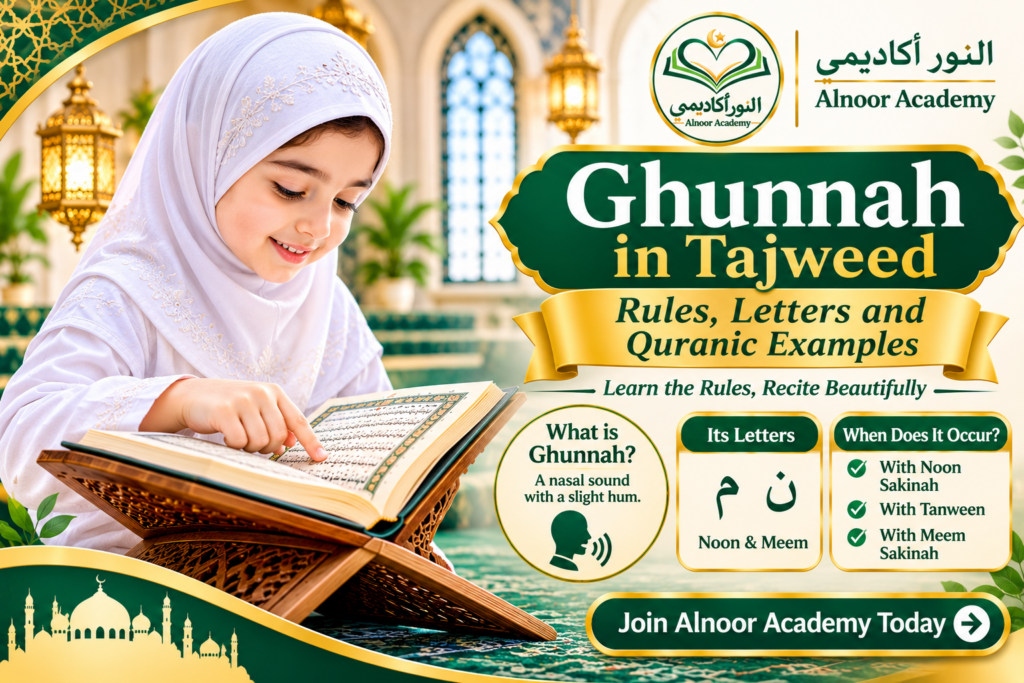
Ghunnah in Tajweed: Rules, Letters and Quranic Examples
Learning Ghunnah is an essential part of mastering Tajweed and improving the pronunciation of the Holy Quran. It is a nasal sound that plays an important role in several Quranic recitation rules.
Understanding Ghunnah helps students develop better pronunciation, improve their recitation, and apply Tajweed rules correctly.
At Alnoor Academy, we provide personalized online Quran and Tajweed classes for children and adults, helping students learn correct Quran recitation with qualified and experienced teachers.
What Is Ghunnah in Tajweed?
Ghunnah is a nasal sound produced through the nasal passage. It is associated with the Arabic letters Noon (ن) and Meem (م).
Ghunnah is an important feature of Quranic recitation and is applied in several Tajweed rules.
Learning how to pronounce Ghunnah correctly helps students improve the quality and accuracy of their recitation.
What Are the Letters of Ghunnah?
The two letters associated with Ghunnah are:
- Noon (ن)
- Meem (م)
These letters produce a nasal sound in specific recitation situations.
Ghunnah is particularly noticeable when Noon or Meem carries a Shaddah.
When Is Ghunnah Applied in Tajweed?
Ghunnah appears in several important Tajweed rules.
1. Noon Mushaddadah
When the letter Noon (ن) carries a Shaddah, Ghunnah must be pronounced for two counts.
Students should practice this sound carefully to achieve correct pronunciation.
2. Meem Mushaddadah
When the letter Meem (م) carries a Shaddah, Ghunnah is also pronounced for two counts.
This rule is essential for correct Quran recitation.
3. Idgham with Ghunnah
Idgham with Ghunnah occurs when Noon Sakinah or Tanween is followed by one of these four letters:
ي، ن، م، و
The Noon sound merges into the following letter with Ghunnah.
4. Ikhfa Haqiqi
Ikhfa Haqiqi occurs when Noon Sakinah or Tanween is followed by one of the fifteen Ikhfa letters.
The Noon sound is concealed with Ghunnah.
5. Iqlab
Iqlab occurs when Noon Sakinah or Tanween is followed by the letter Baa (ب).
The Noon sound changes into a hidden Meem sound accompanied by Ghunnah.
6. Ikhfa Shafawi
Ikhfa Shafawi occurs when Meem Sakinah is followed by the letter Baa (ب).
The Meem sound is pronounced with Ghunnah.
7. Idgham Shafawi
Idgham Shafawi occurs when Meem Sakinah is followed by another Meem.
The two Meem sounds merge into one emphasized Meem with Ghunnah.
How Long Should Ghunnah Last?
In the commonly taught Hafs narration, Ghunnah in its established forms is generally held for two counts.
Students should practice maintaining a balanced nasal sound without shortening or unnecessarily extending it.
Common Mistakes When Pronouncing Ghunnah
Beginners may make several mistakes while learning Ghunnah, including:
- Pronouncing the nasal sound too quickly.
- Extending Ghunnah for an incorrect duration.
- Failing to apply Ghunnah when required.
- Confusing Noon and Meem pronunciation.
- Producing an unclear nasal sound.
- Not practicing the correct articulation.
A qualified Tajweed teacher can help students recognize and correct these mistakes.
How to Practice Ghunnah Effectively
Here are some practical tips for learning Ghunnah:
- Learn the correct pronunciation of Noon and Meem.
- Understand when Ghunnah is required.
- Practice Noon Mushaddadah and Meem Mushaddadah.
- Listen carefully to qualified Quran reciters.
- Repeat short Quranic examples.
- Practice regularly with a Tajweed teacher.
- Receive feedback to improve your pronunciation.
Consistent practice helps students develop accurate and confident Quran recitation.
Why Is Ghunnah Important in Quran Recitation?
Learning Ghunnah offers several benefits:
- Improves Arabic letter pronunciation.
- Helps students apply Tajweed rules correctly.
- Develops better Quran recitation skills.
- Reduces common pronunciation mistakes.
- Builds confidence when reading the Holy Quran.
Ghunnah is an important part of learning Tajweed and should be practiced carefully.
Learn Ghunnah and Tajweed Online with Alnoor Academy
At Alnoor Academy, we believe that every student deserves quality Quran education and individual attention.
Our online Tajweed classes help children and adults understand Quranic pronunciation through structured lessons and practical exercises.
Why Choose Alnoor Academy?
- Qualified and experienced Quran teachers.
- Personalized one-to-one online lessons.
- Tajweed classes for beginners and advanced students.
- Programs for children and adults.
- Flexible learning schedules.
- Continuous feedback and progress monitoring.
- Learn from anywhere in the world.
Our teachers guide students step by step, helping them understand Ghunnah and apply Tajweed rules correctly.
Frequently Asked Questions About Ghunnah
What Does Ghunnah Mean in Tajweed?
Ghunnah is a nasal sound produced through the nasal passage and associated with Noon and Meem.
What Are the Letters of Ghunnah?
The two letters associated with Ghunnah are Noon (ن) and Meem (م).
How Many Counts Is Ghunnah?
In its established forms in the common Hafs narration, Ghunnah is generally held for two counts.
When Is Ghunnah Required?
Ghunnah is required in several Tajweed situations, including Noon Mushaddadah, Meem Mushaddadah, Idgham with Ghunnah, Ikhfa, and Iqlab.
Can Beginners Learn Ghunnah Online?
Yes. Beginners can learn Ghunnah through structured online lessons, listening exercises, Quranic examples, and guidance from qualified teachers.
Start Your Quran Learning Journey with Alnoor Academy
Learning Ghunnah is another important step toward accurate and beautiful Quran recitation.
Whether you are a beginner or want to improve your Tajweed skills, Alnoor Academy is ready to support your learning journey.
Join our online Quran classes and learn with qualified teachers in a friendly and supportive environment.
Start Your Free Trial Today!
Alnoor Academy – Building a Lifelong Love for the Holy Quran.
