
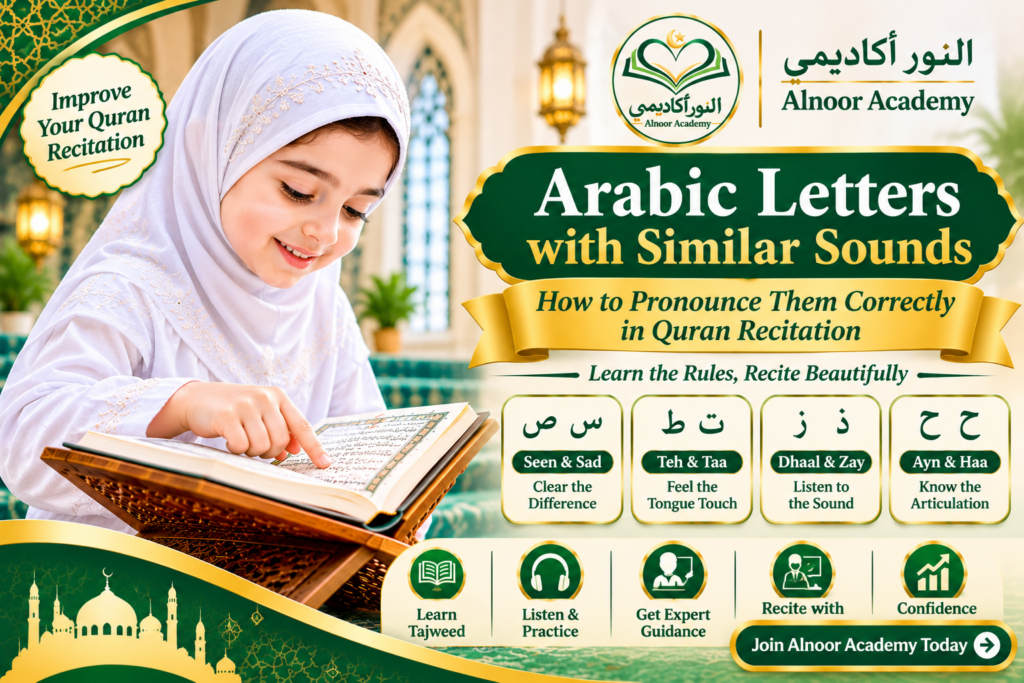
Arabic Letters with Similar Sounds: How to Pronounce Them Correctly in Quran Recitation
Learning Arabic letter pronunciation is one of the most important steps toward mastering Quran recitation. Some Arabic letters have similar sounds, which can make pronunciation challenging for beginners.
Understanding the differences between these letters helps students read the Holy Quran accurately, avoid common mistakes, and develop confidence in their recitation.
At Alnoor Academy, we provide personalized online Quran and Tajweed classes for children and adults, helping students improve their Arabic pronunciation with qualified and experienced teachers.
Why Do Some Arabic Letters Sound Similar?
Arabic contains several letters that may sound similar to beginners. However, each letter has its own articulation point (Makhraj) and characteristics (Sifat).
Even small differences in pronunciation can distinguish one Arabic letter from another.
Learning these differences is essential for correct Quran recitation.
6 Pairs of Arabic Letters That Beginners Often Confuse
1. Seen (س) and Sad (ص)
Both letters are pronounced using the tongue near the upper front teeth, but they have different characteristics.
- Seen (س): A light letter with a clear, flowing sound.
- Sad (ص): A heavy letter pronounced with Tafkheem.
Students should practice both letters carefully to recognize the difference between their sounds.
2. Ta (ت) and Taa (ط)
These letters share a similar articulation area but differ in heaviness.
- Ta (ت): A light letter.
- Taa (ط): A heavy letter.
Understanding Tafkheem and Tarqeeq helps students pronounce these letters correctly.
3. Dhal (ذ) and Zay (ز)
These letters may sound similar to beginners, but their articulation points are different.
- Dhal (ذ): Pronounced with the tip of the tongue near the upper front teeth.
- Zay (ز): Pronounced with the tongue close to the upper front teeth, producing a clear hissing sound.
4. Ha (ح) and Haa (ه)
Both letters originate from the throat, but they come from different articulation areas.
- Ha (ح): A deeper throat sound.
- Haa (ه): A lighter breath-like sound.
Practicing these sounds with a qualified teacher helps students distinguish them.
5. Qaf (ق) and Kaf (ك)
These letters are both produced using the back part of the tongue, but their articulation points are different.
- Qaf (ق): Pronounced from a deeper part of the tongue and is a heavy letter.
- Kaf (ك): Pronounced slightly farther forward and is a light letter.
Correct pronunciation is especially important when reading Quranic words containing these letters.
6. Ayn (ع) and Hamzah (ء)
Both letters originate from the throat, but their sounds are different.
- Ayn (ع): A voiced throat sound that requires proper articulation.
- Hamzah (ء): A clear glottal sound produced by the vocal passage.
Students should practice these letters slowly before using them in complete Quranic verses.
How to Improve Arabic Letter Pronunciation
Learning correct pronunciation requires listening, repetition, and teacher feedback.
Here are some helpful tips:
- Learn the articulation points of Arabic letters.
- Understand the characteristics of each letter.
- Practice similar letters separately.
- Listen to qualified Quran reciters.
- Repeat words containing difficult letters.
- Read Quranic verses slowly and carefully.
- Practice regularly with an experienced Tajweed teacher.
Common Pronunciation Mistakes to Avoid
Many beginners make pronunciation mistakes when learning Arabic letters.
Some common mistakes include:
- Pronouncing heavy letters as light letters.
- Confusing letters with similar articulation points.
- Ignoring the characteristics of Arabic letters.
- Reading too quickly without focusing on pronunciation.
- Depending only on listening without receiving corrections.
A qualified Quran teacher can help identify these mistakes and guide students toward correct pronunciation.
Why Are Makharij Al-Huroof Important?
Makharij Al-Huroof refers to the articulation points of Arabic letters.
Learning these points helps students:
- Pronounce every Arabic letter correctly.
- Distinguish between similar sounds.
- Improve Quran recitation.
- Avoid pronunciation errors.
- Build a strong foundation in Tajweed.
- Read the Holy Quran with greater confidence.
Learn Arabic Pronunciation Online with Alnoor Academy
At Alnoor Academy, we believe that correct Quran recitation begins with learning Arabic letters properly.
Our online Quran and Tajweed classes are designed for children and adults at different learning levels.
Why Choose Alnoor Academy?
- Qualified and experienced Quran teachers.
- Personalized one-to-one online classes.
- Arabic pronunciation and Tajweed lessons.
- Programs for children and adults.
- Flexible learning schedules.
- Individual attention and continuous feedback.
- Learn from anywhere in the world.
Our teachers help students understand the differences between Arabic letters through practical exercises and personalized guidance.
Frequently Asked Questions
Why Do Beginners Confuse Arabic Letters?
Some Arabic letters have similar articulation points or sounds. Beginners need regular listening and pronunciation practice to distinguish them.
How Can I Improve My Arabic Pronunciation?
You can improve by studying Makharij Al-Huroof, listening to correct recitation, practicing regularly, and receiving feedback from a qualified teacher.
What Are the Most Commonly Confused Arabic Letters?
Some commonly confused pairs include Seen and Sad, Ta and Taa, Dhal and Zay, and Ha and Haa.
Can Children Learn Correct Arabic Pronunciation Online?
Yes. Children can learn through interactive lessons, repetition, listening exercises, and individual teacher guidance.
Do I Need to Understand Arabic to Learn Correct Pronunciation?
No. You can learn Arabic letter pronunciation and Quran recitation even if you do not understand the Arabic language.
Start Improving Your Quran Recitation Today!
Learning the correct pronunciation of Arabic letters is an important step toward mastering Tajweed.
Whether you are a beginner or want to improve your Quran reading skills, Alnoor Academy is ready to support your learning journey.
Join our online Quran classes and learn with qualified teachers in a friendly and supportive environment.
Start Your Free Trial Today!
Alnoor Academy – Building a Lifelong Love for the Holy Quran.
