
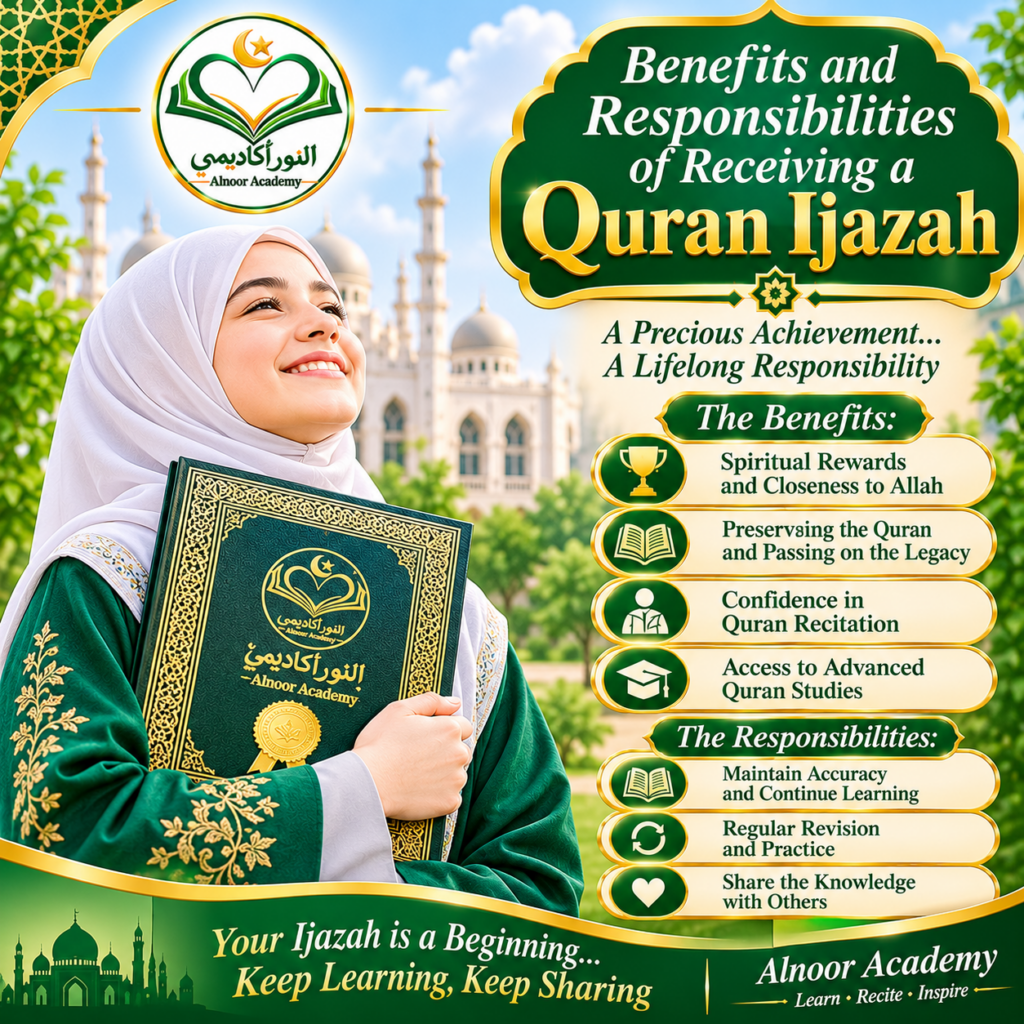
Benefits and Responsibilities of Receiving a Quran Ijazah
Focus Keyword: Benefits of Quran Ijazah
SEO Title: Benefits and Responsibilities of Receiving a Quran Ijazah
Meta Description: Discover the benefits of receiving a Quran Ijazah, the importance of Sanad, and the responsibilities of preserving and teaching the Holy Quran with accuracy.
Benefits and Responsibilities of Receiving a Quran Ijazah
Receiving a Quran Ijazah is a meaningful milestone in the journey of learning and reciting the Holy Quran. It represents the achievement of a required level of proficiency under the guidance of a qualified Quran teacher.
However, a Quran Ijazah is more than an academic achievement. It also carries important responsibilities related to preserving accurate recitation, respecting the tradition of Quran transmission, and sharing knowledge responsibly.
In this guide, we will explore the main benefits of receiving a Quran Ijazah and the responsibilities every student should understand before pursuing this important qualification.
What Does Receiving a Quran Ijazah Mean?
A Quran Ijazah is an authorization granted by a qualified teacher to a student who has fulfilled the requirements of a particular Quran recitation or memorization pathway.
In traditional recitation studies, the Ijazah may include a connected Sanad documenting the chain of transmission through which the recitation has been passed down.
The exact scope of an Ijazah depends on the type of authorization, the Riwayah or Qira’ah studied, and the teacher’s qualifications.
7 Important Benefits of Receiving a Quran Ijazah
1. Mastering Accurate Quran Recitation
One of the most important benefits of pursuing a Quran Ijazah is developing a high level of accuracy in Quran recitation.
Students work on:
- Correct pronunciation of Arabic letters.
- Proper articulation points.
- Accurate application of Tajweed.
- Consistent recitation.
- Avoiding common pronunciation mistakes.
This learning process helps students strengthen their relationship with the Holy Quran.
2. Understanding the Importance of Sanad
A connected Sanad provides a documented chain of transmission linking the student’s authorization to the established tradition of Quran recitation.
Studying Sanad helps students appreciate the care, knowledge, and responsibility involved in transmitting Quranic recitation.
3. Developing Advanced Tajweed Skills
Preparing for a Quran Ijazah requires students to improve their practical Tajweed knowledge.
They learn to apply important rules, including:
- Makharij Al-Huruf.
- Sifat Al-Huruf.
- Noon Sakinah and Tanween.
- Meem Sakinah.
- Madd rules.
- Qalqalah.
- Waqf and Ibtida.
These skills support accurate and confident Quran recitation.
4. Building Discipline and Consistency
The journey toward receiving a Quran Ijazah requires dedication and regular revision.
Students develop valuable habits such as:
- Maintaining a consistent study routine.
- Reviewing memorized portions.
- Listening carefully to their teachers.
- Accepting corrections.
- Setting realistic learning goals.
These habits can benefit students beyond their Quran studies.
5. Preparing for Advanced Quran Education
An Ijazah can provide an important foundation for students interested in further studies in Quran recitation and the recognized Qira’at.
Depending on their qualifications and goals, students may continue studying:
- Other Riwayat.
- Advanced Tajweed.
- Multiple Qira’at.
- Quranic transmission.
- Advanced Quran teaching methods.
Further study always depends on the requirements of each educational pathway.
6. Developing Teaching Skills
Students who receive appropriate authorization may be prepared to teach the specific recitation covered by their Ijazah, provided they also possess the necessary teaching ability.
They can develop skills in:
- Explaining Tajweed rules.
- Correcting recitation mistakes.
- Guiding Quran learners.
- Encouraging consistent revision.
- Creating supportive learning environments.
7. Strengthening Your Connection with the Holy Quran
The process of studying, memorizing, revising, and reciting the Quran can deepen a student’s appreciation of its meanings and guidance.
The journey encourages patience, humility, dedication, and continuous learning.
Responsibilities of Receiving a Quran Ijazah
Receiving an Ijazah is an achievement that should be accompanied by a strong sense of responsibility.
Here are some important responsibilities for Ijazah holders.
1. Preserving Accurate Recitation
An Ijazah holder should continue reviewing and maintaining the recitation standards learned from their teacher.
Regular revision helps preserve accuracy and consistency.
2. Teaching Within the Scope of Authorization
Students should teach only within the scope of their actual qualifications and authorization.
Receiving an Ijazah in one Riwayah does not automatically authorize someone to teach every other Qira’ah or narration.
3. Maintaining Continuous Learning
An Ijazah does not mean that learning has ended.
Students should continue improving their knowledge, reviewing Tajweed, and benefiting from qualified scholars and teachers.
4. Respecting the Sanad
An Ijazah holder should accurately represent their qualifications and transmission chain.
They should never make unsupported claims about their Sanad or the scope of their authorization.
5. Demonstrating Good Character
A Quran teacher should demonstrate patience, humility, honesty, and respect toward students.
Teaching the Holy Quran requires not only knowledge but also responsible conduct and a sincere commitment to learning.
6. Correcting Students with Wisdom
When teaching Quran recitation, instructors should correct mistakes clearly and respectfully.
Encouragement and constructive feedback help students develop confidence and improve their skills.
Can You Become a Quran Teacher After Receiving Ijazah?
An Ijazah may qualify a student to teach the specific recitation covered by the authorization, depending on its scope.
However, effective Quran teaching also requires:
- Appropriate teaching skills.
- Clear communication.
- Knowledge of student learning needs.
- Patience and professional conduct.
- Understanding of the relevant curriculum.
An Ijazah is an important qualification, but good teaching also requires preparation and experience.
How Can You Begin Your Quran Ijazah Journey?
If you want to pursue a Quran Ijazah, start by following a structured learning pathway.
Step 1: Assess Your Quran Reading Level
Understand your current recitation and memorization skills.
Step 2: Strengthen Your Tajweed
Learn and apply the rules of Quran recitation.
Step 3: Study with a Qualified Teacher
Choose a teacher with appropriate qualifications for your selected Ijazah pathway.
Step 4: Maintain Regular Revision
Develop a consistent schedule for memorization and recitation practice.
Step 5: Complete the Required Assessment
Demonstrate the proficiency required by your teacher.
Step 6: Understand Your Authorization
Clarify the type of Ijazah, Riwayah, and Sanad included in your qualification.
Begin Your Quran Ijazah Journey with Alnoor Academy
At Alnoor Academy, we believe that learning the Holy Quran is a lifelong journey built on knowledge, dedication, and proper guidance.
Our online Quran programs are designed for children and adults worldwide. We help students improve their Quran recitation, develop Tajweed skills, strengthen memorization, and prepare for advanced Quran studies.
Through personalized lessons and qualified teachers, students can progress according to their individual levels and educational goals.
Whether you want to improve your recitation or prepare for a Quran Ijazah pathway, Alnoor Academy is here to support your learning journey.
Why Choose Alnoor Academy?
- Qualified and experienced Quran teachers.
- Personalized online lessons.
- Programs for children and adults.
- Flexible lesson schedules.
- Learning opportunities from anywhere in the world.
Start Your Free Trial Today!
Take your next step toward mastering the Holy Quran with Alnoor Academy.
Frequently Asked Questions
What are the main benefits of receiving a Quran Ijazah?
A Quran Ijazah demonstrates that a student has fulfilled the requirements of a specific authorization. It can support advanced Quran studies and, within its scope, qualify the holder to teach the relevant recitation.
Does every Quran Ijazah include a connected Sanad?
Not every certificate or authorization has the same scope. Students should verify whether the Ijazah includes a connected Sanad and what recitation it covers.
Can I teach the Quran after receiving Ijazah?
You may teach within the scope of your authorization if you have the necessary teaching ability and fulfill the relevant responsibilities.
Does Quran Ijazah qualify me to teach all Qira’at?
No. An authorization generally applies to the specific Riwayah or Qira’ah covered by the teacher’s assessment and grant.
Should I continue learning after receiving Ijazah?
Yes. Continuous revision, learning, and improving teaching skills are important responsibilities.
Can I pursue Quran Ijazah online?
Yes. Live online study with a qualified teacher can provide a suitable pathway when the requirements and assessments are properly fulfilled.
Conclusion
Receiving a Quran Ijazah is an important achievement that combines knowledge, dedication, and responsibility.
It represents a commitment to accurate Quran recitation, respect for the tradition of transmission, and responsible teaching within the scope of one’s authorization.
With qualified guidance, continuous revision, and sincere dedication, students can make meaningful progress in their Quran learning journey.
Alnoor Academy – Your Journey to Mastering the Holy Quran Starts Here!
