
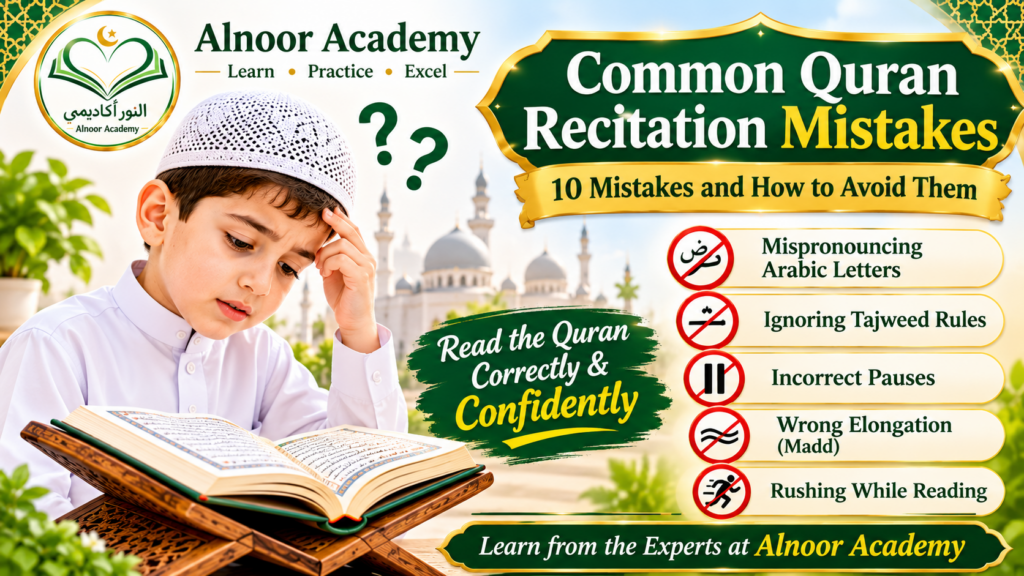
Common Quran Recitation Mistakes: 10 Mistakes and How to Avoid Them
Introduction
Reading the Holy Quran correctly is an important part of every Muslim’s learning journey. However, some students may make pronunciation or reading mistakes, especially when they are beginners or learning Arabic as a second language.
Understanding common Quran recitation mistakes is the first step toward improving your reading skills and applying Tajweed correctly.
At Alnoor Academy, we help children and adults improve their Quran recitation through personalized online lessons with qualified teachers.
In this guide, we will explore ten common mistakes in Quran recitation and explain how to avoid them.
1. Mispronouncing Arabic Letters
One of the most common Quran recitation mistakes is pronouncing Arabic letters incorrectly.
Some Arabic letters have similar sounds, which can make them difficult for beginners.
How to avoid it:
- Learn the articulation points (Makharij) of Arabic letters.
- Practice difficult letters individually.
- Listen carefully to correct pronunciation.
- Ask a qualified teacher to evaluate your reading.
2. Ignoring Tajweed Rules
Tajweed rules help readers pronounce Quranic words correctly. Ignoring these rules may lead to inaccurate recitation.
How to avoid it:
Study Tajweed gradually, beginning with basic rules such as Noon Sakinah, Tanween, Meem Sakinah, and Madd.
3. Reading Too Quickly
Some students rush through Quranic verses without giving enough attention to pronunciation and clarity.
How to avoid it:
Read slowly and carefully. Focus on accuracy before trying to increase your reading speed.
4. Incorrect Madd (Elongation)
Madd refers to extending certain vowel sounds according to specific Tajweed rules.
Incorrect elongation can affect the quality and accuracy of recitation.
How to avoid it:
Learn the different types of Madd and practice them with a qualified Quran teacher.
5. Making Incorrect Pauses
Stopping at inappropriate places or continuing when a pause is required can affect the meaning and flow of Quranic verses.
How to avoid it:
Study the basic rules of Waqf and Ibtida (stopping and starting) and learn the signs of stopping in the Mushaf.
6. Confusing Similar Arabic Letters
Letters such as س and ص or ت and ط require careful pronunciation.
How to avoid it:
Practice similar letters separately and learn their individual characteristics (Sifat Al-Huroof).
7. Neglecting Regular Practice
Learning Quran recitation without consistent practice can make it difficult to remember previous lessons.
How to avoid it:
Create a daily reading routine. Even a short, consistent practice session can help reinforce what you have learned.
8. Depending Only on Listening
Listening to skilled Quran reciters is useful, but it does not replace personal practice and teacher feedback.
How to avoid it:
Listen, follow along with the Mushaf, recite aloud, and ask a qualified teacher to review your pronunciation.
9. Not Reviewing Previous Lessons
Moving to advanced Tajweed topics without reviewing basic rules can create gaps in learning.
How to avoid it:
Set aside time to revise previous lessons and practice the rules you have already studied.
10. Learning Without Qualified Guidance
Self-learning can be helpful, but some pronunciation mistakes are difficult to recognize without expert feedback.
How to avoid it:
Learn with a qualified Quran teacher who can listen to your recitation, identify mistakes, and guide you toward improvement.
How Online Quran Classes Help You Avoid Recitation Mistakes
Online Quran classes provide an opportunity to learn directly from experienced teachers.
At Alnoor Academy, students receive:
- Individual Quran recitation lessons.
- Practical Tajweed instruction.
- Correction of pronunciation mistakes.
- Personalized learning plans.
- Lessons for children and adults.
- Flexible online classes from anywhere in the world.
Our teachers help students build accurate reading habits through regular practice and individual feedback.
Conclusion
Avoiding common Quran recitation mistakes requires patience, regular practice, and proper guidance.
By learning Tajweed, improving Arabic pronunciation, and reviewing your lessons, you can gradually develop better Quran reading skills.
Join Alnoor Academy and let our qualified teachers guide you toward more accurate and confident Quran recitation.
[Start Your Free Trial Today]
