
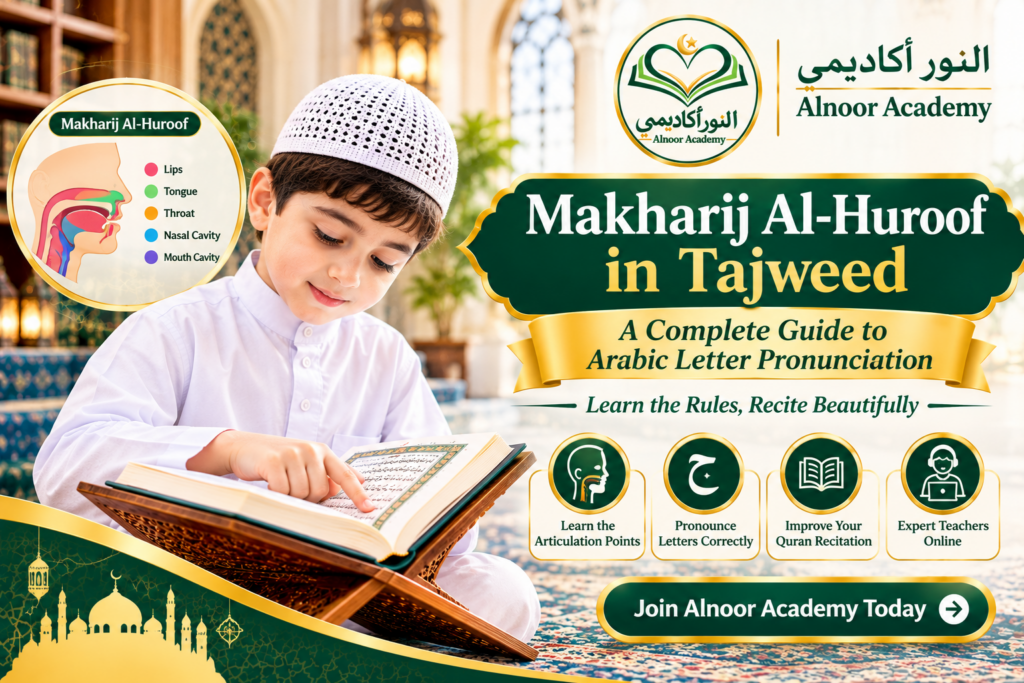
Makharij Al-Huroof in Tajweed: A Complete Guide to Arabic Letter Pronunciation
Learning the correct pronunciation of Arabic letters is one of the most important steps in mastering Quran recitation. In Tajweed, the articulation points of Arabic letters are known as Makharij Al-Huroof.
Understanding these articulation points helps students pronounce every Arabic letter correctly and avoid common mistakes when reading the Holy Quran.
Whether you are a beginner, an adult learner, or a parent looking for Quran lessons for your child, learning Makharij Al-Huroof will help build a strong foundation in Quran recitation.
At Alnoor Academy, we provide personalized online Quran and Tajweed classes for children and adults, helping students improve their pronunciation with qualified teachers.
What Are Makharij Al-Huroof?
Makharij Al-Huroof refers to the specific places in the mouth and throat from which Arabic letters are pronounced.
Every Arabic letter has an articulation point that helps distinguish it from other letters.
Learning these points is essential for correct Quran recitation because changing the pronunciation of a letter may affect the meaning of a word.
The Five Main Articulation Areas in Tajweed
According to the commonly taught system of 17 detailed articulation points, Arabic letters originate from five main areas.
1. Al-Jawf (The Empty Space)
Al-Jawf refers to the empty space in the mouth and throat.
It is the articulation area for the three Madd letters:
- Alif (ا)
- Waw (و)
- Yaa (ي)
These letters are used in natural elongation during Quran recitation.
2. Al-Halq (The Throat)
Al-Halq refers to the throat, which has three articulation areas.
Six Arabic letters originate from the throat:
- ء، ه
- ع، ح
- غ، خ
They are divided into the deepest, middle, and upper parts of the throat.
3. Al-Lisan (The Tongue)
Al-Lisan refers to the tongue, which produces the largest number of Arabic letters.
Several letters originate from different parts of the tongue, including:
- ق، ك
- ج، ش، ي
- ض
- ل، ن، ر
- ط، د، ت
- ص، ز، س
- ظ، ذ، ث
Understanding tongue articulation helps students distinguish between letters that may sound similar.
4. Ash-Shafatan (The Two Lips)
Ash-Shafatan refers to the two lips.
Four Arabic letters are associated with this articulation area:
- ف
- ب
- م
- و
Correct lip movement is important for producing these sounds accurately.
5. Al-Khayshum (The Nasal Passage)
Al-Khayshum is the nasal passage from which the sound of Ghunnah originates.
Ghunnah is an important nasal sound associated with Noon and Meem in specific Tajweed situations.
Students should practice listening to and producing Ghunnah correctly.
Why Are Makharij Al-Huroof Important?
Learning articulation points offers several benefits:
- Helps students pronounce Arabic letters correctly.
- Reduces common Quran recitation mistakes.
- Improves reading fluency and clarity.
- Helps distinguish between similar Arabic sounds.
- Builds a strong foundation for learning Tajweed.
- Develops confidence in Quran recitation.
Common Mistakes in Arabic Letter Pronunciation
Beginners sometimes confuse letters that have similar sounds or articulation points.
Some common examples include:
- Confusing س and ص.
- Confusing ت and ط.
- Confusing ذ and ز.
- Confusing ح and ه.
- Pronouncing ع without its proper articulation.
A qualified Quran teacher can help students identify these mistakes and practice the correct pronunciation.
How to Learn Makharij Al-Huroof Effectively
Learning articulation points requires listening, practice, and individual feedback.
Here are some helpful steps:
- Start by learning the Arabic alphabet.
- Understand the five main articulation areas.
- Practice each letter separately.
- Listen carefully to qualified Quran reciters.
- Repeat Arabic sounds and Quranic words.
- Practice reading short Quranic verses.
- Read with a qualified Tajweed teacher who can correct your pronunciation.
Regular practice will help students develop accurate Arabic pronunciation.
Learn Makharij Al-Huroof Online with Alnoor Academy
At Alnoor Academy, we believe that correct Quran recitation begins with learning the Arabic letters properly.
Our online Quran and Tajweed programs are designed to help children and adults improve their pronunciation through structured lessons and personalized teacher guidance.
Why Choose Alnoor Academy?
- Qualified and experienced Quran teachers.
- Private one-to-one online lessons.
- Tajweed classes for beginners and advanced students.
- Programs for children and adults.
- Flexible learning schedules.
- Individual attention and continuous feedback.
- Online learning from anywhere in the world.
Our teachers guide students step by step, helping them understand the articulation points and apply them during Quran recitation.
Frequently Asked Questions About Makharij Al-Huroof
How Many Main Articulation Areas Are There?
There are five main articulation areas: Al-Jawf, Al-Halq, Al-Lisan, Ash-Shafatan, and Al-Khayshum.
How Many Detailed Makharij Are There?
According to the commonly taught system, there are 17 detailed articulation points.
Why Should Beginners Learn Makharij First?
Learning articulation points helps beginners pronounce Arabic letters correctly before moving to more advanced Tajweed rules.
Can Children Learn Makharij Al-Huroof Online?
Yes. Children can learn through interactive lessons, repetition, listening exercises, and individual teacher guidance.
Do I Need to Know Arabic to Learn Makharij?
No. You can begin learning Arabic letter pronunciation without understanding the Arabic language.
Start Learning Quran Recitation with Alnoor Academy
Learning Makharij Al-Huroof is an essential step toward accurate and beautiful Quran recitation.
Whether you are beginning your Quran journey or improving your existing skills, Alnoor Academy is ready to guide you.
Join our online Quran classes and learn with qualified teachers in a friendly and supportive environment.
Start Your Free Trial Today!
Alnoor Academy – Building a Lifelong Love for the Holy Quran.
