
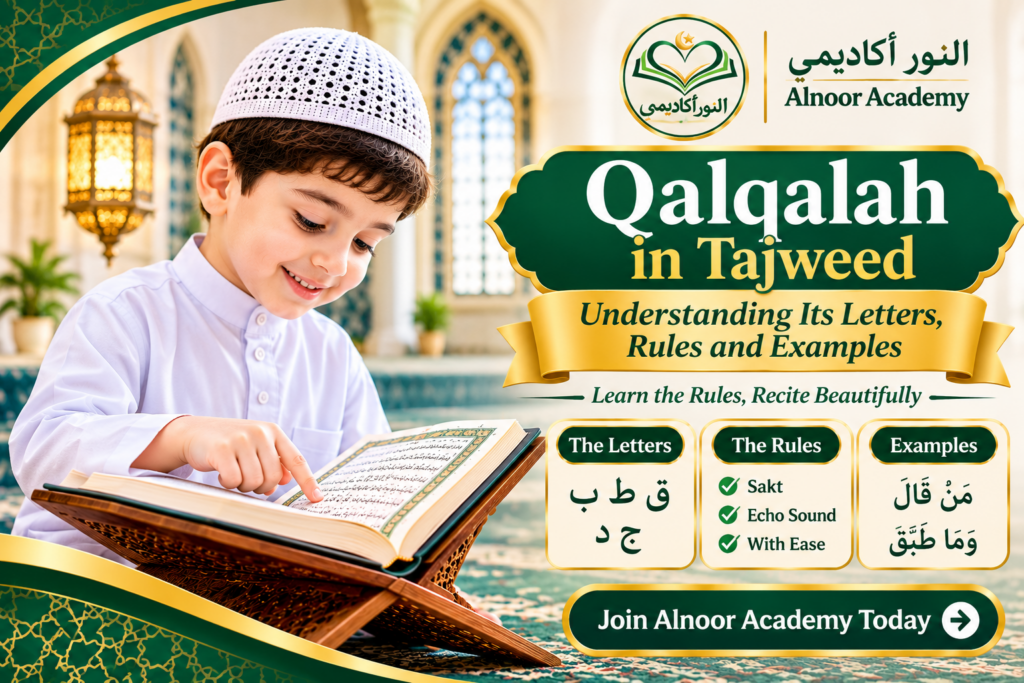
Qalqalah in Tajweed: Understanding Its Letters, Rules and Examples
Learning Qalqalah is an important step toward mastering Tajweed and improving Quran recitation. It is one of the essential pronunciation rules that helps students recite the Holy Quran correctly and clearly.
For beginners, understanding Qalqalah may seem challenging, but with simple explanations and regular practice, students can learn how to apply this rule naturally.
At Alnoor Academy, we offer personalized online Tajweed classes for children and adults, helping students improve their Quran recitation with qualified and experienced teachers.
What Is Qalqalah in Tajweed?
Qalqalah is an Arabic Tajweed rule that refers to a slight echoing or bouncing sound produced when one of the five Qalqalah letters carries a Sukoon.
The purpose of Qalqalah is to make the sound of the letter clear without adding an extra vowel.
Learning this rule helps students improve their pronunciation and avoid common Quran recitation mistakes.
What Are the Five Qalqalah Letters?
There are five Qalqalah letters in Arabic:
ق، ط، ب، ج، د
Students often memorize these letters through the phrase:
قُطْبُ جَدٍّ
These letters produce the Qalqalah sound when they carry a Sukoon.
What Are the Types of Qalqalah?
Qalqalah is commonly explained through three levels of application:
1. Qalqalah Sughra (Minor Qalqalah)
Qalqalah Sughra occurs when a Qalqalah letter carries an original Sukoon in the middle of a word.
The echoing sound is light and should be pronounced clearly without exaggeration.
2. Qalqalah Kubra (Major Qalqalah)
Qalqalah Kubra occurs when stopping at a word that ends with a Qalqalah letter.
The echoing sound is more noticeable because the reader stops on the letter.
3. Qalqalah Akbar (Strongest Qalqalah)
Qalqalah Akbar is commonly described as a stronger form when stopping on a doubled Qalqalah letter (a letter with Shaddah).
Students should learn the differences through listening and practical Quran recitation.
Examples of Qalqalah in the Holy Quran
Here are some examples that help students recognize Qalqalah letters:
- يَجْعَلُونَ – The letter Jeem carries Sukoon.
- أَحَدْ – When stopping on the final letter Daal.
- الْفَلَقْ – When stopping on the final letter Qaaf.
- وَتَبَّ – When stopping on the final doubled letter Baa.
Practicing these examples helps students understand how Qalqalah works in different Quranic situations.
How to Pronounce Qalqalah Correctly
To apply Qalqalah correctly, students should follow these steps:
- Identify the five Qalqalah letters.
- Recognize when one of these letters carries Sukoon.
- Produce a clear and slight echoing sound.
- Avoid adding an extra vowel after the letter.
- Practice different examples from the Holy Quran.
- Listen to qualified Quran reciters.
- Read with a Tajweed teacher to correct pronunciation.
Regular practice helps students develop accurate pronunciation and better recitation skills.
Common Mistakes When Learning Qalqalah
Some beginners make mistakes while applying Qalqalah.
Common mistakes include:
- Forgetting to apply Qalqalah when required.
- Adding an unnecessary vowel sound.
- Making the echoing sound too strong.
- Confusing Qalqalah Sughra with Qalqalah Kubra.
- Pronouncing the five letters incorrectly.
- Reading too quickly without observing Tajweed rules.
A qualified Quran teacher can help students identify and correct these mistakes.
Why Is Learning Qalqalah Important?
Learning Qalqalah offers several benefits:
- Improves Quran pronunciation.
- Helps students recognize important Tajweed rules.
- Develops confidence in Quran recitation.
- Reduces common pronunciation mistakes.
- Builds a strong foundation for advanced Tajweed lessons.
- Improves the clarity of Quranic letters.
Learn Qalqalah Online with Alnoor Academy
At Alnoor Academy, we believe that every student deserves the opportunity to learn the Holy Quran correctly.
Our online Tajweed classes are designed to help children and adults understand Tajweed rules through simple explanations and practical exercises.
Why Choose Alnoor Academy?
- Qualified and experienced Quran teachers.
- Personalized one-to-one online classes.
- Tajweed lessons for beginners and advanced students.
- Programs for children and adults.
- Flexible learning schedules.
- Individual attention and continuous feedback.
- Online learning from anywhere in the world.
Our teachers guide students step by step, helping them apply Tajweed rules with confidence.
Frequently Asked Questions About Qalqalah
What Are the Five Letters of Qalqalah?
The five letters are Qaaf, Taa, Baa, Jeem, and Daal (ق، ط، ب، ج، د).
When Does Qalqalah Occur?
Qalqalah occurs when one of its five letters carries Sukoon.
How Many Types of Qalqalah Are There?
Qalqalah is commonly taught in three levels: Sughra, Kubra, and Akbar.
Is Qalqalah Difficult for Beginners?
No. Beginners can learn Qalqalah through simple explanations, listening exercises, and regular practice.
Can Children Learn Qalqalah Online?
Yes. Children can learn Qalqalah through interactive Quran lessons, repetition, practical examples, and individual teacher guidance.
Start Your Quran Learning Journey with Alnoor Academy
Learning Qalqalah is an important step toward accurate and beautiful Quran recitation.
Whether you are a beginner or want to improve your Tajweed skills, Alnoor Academy is ready to support your learning journey.
Join our online Quran classes and learn with qualified teachers in a friendly and supportive environment.
Start Your Free Trial Today!
Alnoor Academy – Building a Lifelong Love for the Holy Quran.
