
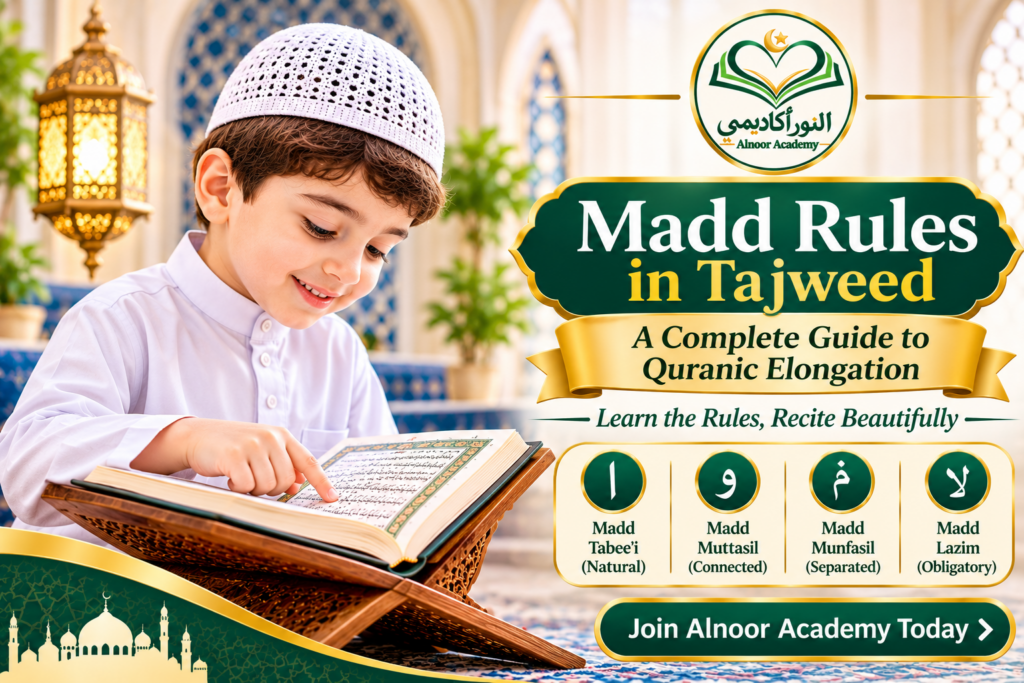
Madd Rules in Tajweed: A Complete Guide to Quranic Elongation
Learning the rules of Madd is an essential part of mastering Tajweed and improving Quran recitation. Madd refers to extending specific vowel sounds for a particular duration according to the rules of Quranic recitation.
Understanding Madd helps students recite the Holy Quran accurately, maintain proper pronunciation, and develop a more beautiful recitation.
At Alnoor Academy, we help children and adults learn Tajweed step by step through personalized online Quran lessons with qualified teachers.
What Is Madd in Tajweed?
Madd is an Arabic word meaning elongation or extension.
In Tajweed, Madd refers to extending the sound of a Madd letter for a specific number of counts.
There are three Madd letters:
-
- Alif (ا) preceded by Fathah.
-
- Waw (و) preceded by Dammah.
-
- Yaa (ي) preceded by Kasrah.
These letters are the foundation of learning the different types of Madd in the Holy Quran.
What Are the Main Types of Madd?
Madd is generally divided into two main categories:
-
- Madd Asli (Natural Madd).
-
- Madd Far’i (Secondary Madd).
Let’s explore the most important types.
1. Madd Asli (Natural Madd)
Madd Asli is also known as Madd Tabee’i.
It occurs when one of the three Madd letters is not followed by a Hamzah or Sukoon that causes a secondary Madd.
The natural Madd is extended for two counts.
Learning this rule is the first step toward understanding Quranic elongation.
2. Madd Muttasil (Connected Madd)
Madd Muttasil occurs when a Madd letter is followed by a Hamzah in the same word.
It is commonly extended for four or five counts in the Hafs narration, according to the recitation method being followed.
This rule is important for maintaining correct Quranic pronunciation.
3. Madd Munfasil (Separated Madd)
Madd Munfasil occurs when a Madd letter comes at the end of one word and a Hamzah begins the following word.
In the common Hafs reading through the Shatibiyyah route, it is generally extended for four or five counts.
Students should practice this rule with a qualified teacher to maintain consistency.
4. Madd Lazim (Necessary Madd)
Madd Lazim occurs when a Madd letter is followed by an original Sukoon.
It is extended for six counts.
Madd Lazim has different categories, including:
-
- Madd Lazim Kalimi Muthaqqal.
-
- Madd Lazim Kalimi Mukhaffaf.
-
- Madd Lazim Harfi Muthaqqal.
-
- Madd Lazim Harfi Mukhaffaf.
Each category has its own application in Quranic recitation.
5. Madd Arid Lis-Sukoon (Temporary Madd)
This type occurs when a reader stops at a word whose final letter becomes silent because of stopping.
It can be extended for two, four, or six counts in the common Hafs method.
Students should learn how to apply it correctly when stopping at the end of Quranic verses.
6. Madd Badal
Madd Badal occurs when a Hamzah is followed by a Madd letter in the same word.
In the Hafs narration, it is generally extended for two counts.
It is another important rule that students should recognize during Quran recitation.
Why Is Learning Madd Important?
Learning Madd rules helps students:
-
- Improve Quran pronunciation.
-
- Understand the correct duration of vowel sounds.
-
- Avoid common recitation mistakes.
-
- Develop better fluency.
-
- Apply Tajweed rules confidently.
-
- Improve the overall quality of Quran recitation.
Common Mistakes When Applying Madd Rules
Beginners sometimes make mistakes while practicing Madd.
Some common mistakes include:
-
- Extending natural Madd for an incorrect duration.
-
- Confusing Madd Muttasil with Madd Munfasil.
-
- Not recognizing the Hamzah after a Madd letter.
-
- Applying incorrect elongation when stopping.
-
- Reading too quickly without observing the Madd rules.
Learning with a qualified Quran teacher can help students identify and correct these mistakes.
How to Learn Madd Rules Easily
Here are some practical steps:
-
- Learn the three Madd letters.
-
- Understand the difference between natural and secondary Madd.
-
- Study one Madd rule at a time.
-
- Listen to qualified Quran reciters.
-
- Practice using short Quranic verses.
-
- Read aloud with an experienced Tajweed teacher.
-
- Review the correct counts regularly.
Regular practice and individual feedback will help students improve their recitation.
Learn Madd Rules Online with Alnoor Academy
At Alnoor Academy, we believe that every student deserves high-quality Quran education.
Our online Tajweed classes help students understand the rules of Quran recitation through structured lessons and personalized guidance.
Why Choose Alnoor Academy?
-
- Qualified and experienced Quran teachers.
-
- Personalized one-to-one lessons.
-
- Tajweed classes for children and adults.
-
- Programs for beginners and advanced learners.
-
- Flexible learning schedules.
-
- Continuous feedback and progress monitoring.
-
- Online learning from anywhere in the world.
Our teachers explain Tajweed rules using practical examples to help students understand and apply each lesson.
Frequently Asked Questions About Madd in Tajweed
What Does Madd Mean in Tajweed?
Madd means extending a vowel sound according to specific Quranic recitation rules.
How Many Madd Letters Are There?
There are three Madd letters: Alif, Waw, and Yaa.
How Long Is Natural Madd?
Natural Madd is extended for two counts.
What Is the Difference Between Madd Muttasil and Madd Munfasil?
Madd Muttasil occurs when the Madd letter and Hamzah appear in the same word, while Madd Munfasil occurs when they appear in two separate words.
Can Beginners Learn Madd Rules Online?
Yes. Beginners can learn Madd through structured lessons, practical Quranic examples, and guidance from qualified Tajweed teachers.
Start Your Quran Learning Journey with Alnoor Academy
Learning Madd rules is an important step toward accurate and beautiful Quran recitation.
Whether you are a beginner or want to improve your existing Tajweed knowledge, Alnoor Academy is ready to support your learning journey.
Join our online Quran classes and learn with qualified teachers in a friendly and supportive environment.
Start Your Free Trial Today!
Alnoor Academy – Building a Lifelong Love for the Holy Quran.
